
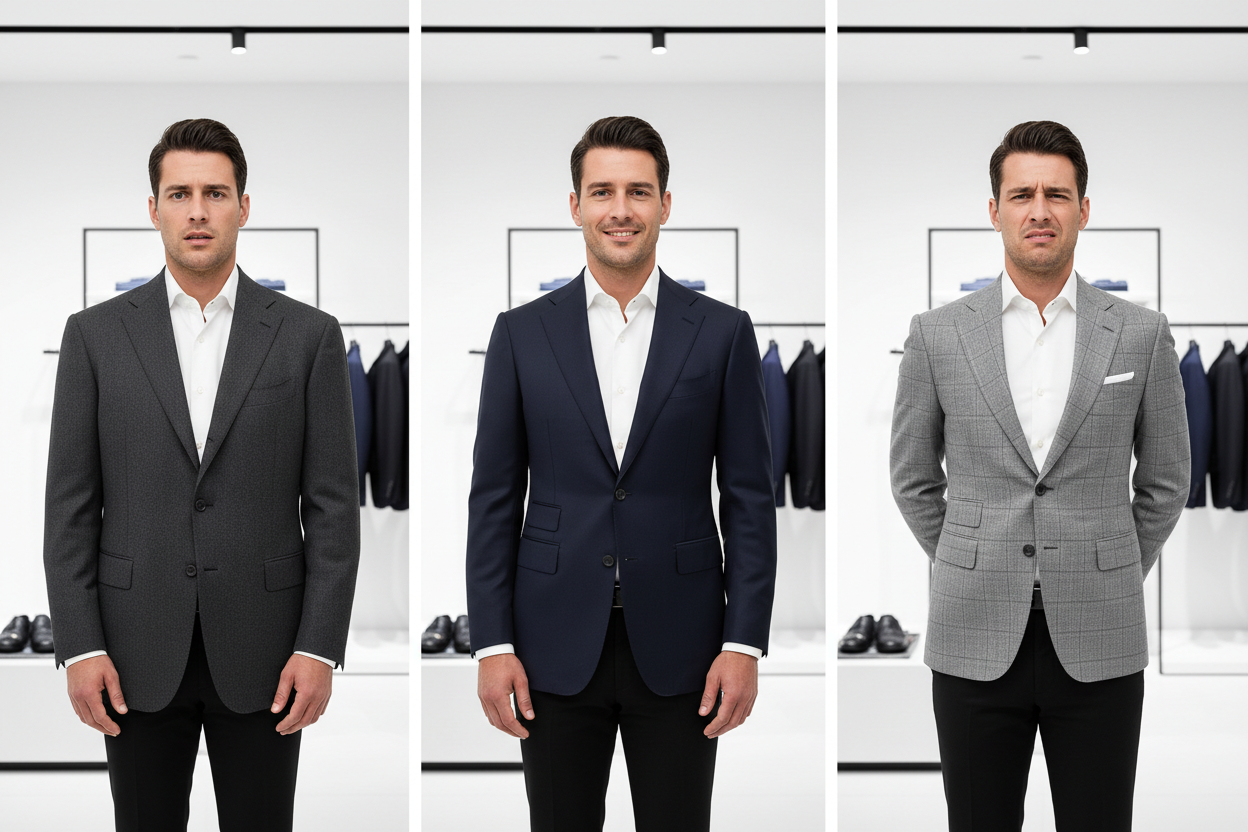
A jacket that fits perfectly doesn't just look better — it changes how you carry yourself. This guide covers every measurement, every fit cue, and every detail you need to find your ideal jacket, whether you're shopping ready-to-wear or commissioning a bespoke piece.

Chapter 01
Why Jacket Fit Is the Foundation of Every Great Look
No fabric, no brand name, and no price tag can compensate for a jacket that doesn't fit. The silhouette of a well-fitted jacket frames the body, creates visual structure, and communicates confidence before you say a word. A jacket that pulls across the back, sags at the shoulders, or bunches at the waist undermines even the finest cloth.
Understanding fit is not about chasing a trend — it's about understanding your body and knowing what to look for. Once you know your measurements and the key fit checkpoints, finding the right jacket becomes straightforward and repeatable.
The Three Pillars of Jacket Fit
Shoulder alignment — the single most critical and hardest to alter
Chest and torso balance — determines how the jacket drapes and buttons
Length and sleeve proportion — frames the overall silhouette

Chapter 02
How to Take Your Measurements Accurately
Accurate measurements are the starting point for every great fit. You'll need a soft cloth tape measure and ideally a second person to assist. Always measure over a fitted shirt — not a thick sweater — and stand naturally without tensing up.
Measurement 01
Chest
Wrap the tape around the fullest part of your chest, just under your arms and across your shoulder blades. Keep the tape parallel to the floor and snug but not tight. This is your primary sizing number.
Measurement 02
Shoulders
Measure from the edge of one shoulder seam to the other across the back. Shoulder seams that sit off the natural shoulder point are the most difficult alteration to correct.
Measurement 03
Sleeve Length
Measure from the top of your shoulder, over a slightly bent elbow, down to your wrist bone. A well-fitted jacket sleeve should reveal approximately 1–1.5 cm of shirt cuff.
Measurement 04
Back Length
Measure from the base of your neck straight down to where you'd like the jacket to end — typically at the base of your seat or the knuckle of your thumb when your arms hang naturally.
Measurement 05
Waist
Measure around your natural waist — the narrowest point of your torso, typically 2–3 cm above your navel. This determines how much suppression you need in the jacket body.

Chapter 03
Understanding Jacket Size Charts and Sizing Systems
Jacket sizing varies by region and brand. Understanding the system used by your chosen brand prevents costly mistakes when ordering online.
“The right size is not the one that fits the label — it's the one that fits your body.”

Chapter 04
Reading the Fit — What to Look For When You Try On a Jacket
Numbers get you close. Your eyes and hands confirm the fit. Here's what to check at every point of the jacket.
Shoulders
The shoulder seam should sit exactly at the edge of your natural shoulder. Press your finger along the seam: it should lie flat with no divots or ripples. This is non-negotiable — shoulder alterations are expensive and structurally complex.
Chest & Button Stance
When buttoned, the jacket should close cleanly with no pulling or X-shaped creasing. You should be able to slide a flat hand inside with slight resistance. If the lapels bow outward, the chest is too small.
Back Panel
The back should lie flat with no horizontal creases (too tight) or vertical folds (too loose). The centre seam should run straight down your spine.
Sleeve Length
With your arms at your sides, the jacket sleeve should end at your wrist bone, revealing 1–1.5 cm of shirt cuff. This proportion is a classic marker of a well-dressed man.
Jacket Length
The jacket hem should cover your seat and align roughly with the knuckle of your thumb. Too short reads casual; too long reads dated.
Waist Suppression
A quality jacket should follow the natural taper of your torso. There should be a visible waist — not a boxy straight line from chest to hem. Some shape is always more refined.

Chapter 05
Choosing the Right Cut for Your Body Type
Beyond measurements, the cut of a jacket — its overall silhouette — should complement your natural proportions.
Chapter 06
Common Fit Problems and How to Fix Them
Even with careful measurement, off-the-rack jackets sometimes need adjustment. Here are the most common issues and their solutions.
Pro tip: Always budget for minor alterations when buying ready-to-wear. A modest alteration on a quality jacket is always worth it — it's the difference between a jacket you own and a jacket you wear.
FAQ