
The Wedding Season Suit Guide
When to Wear It, Why It Matters & How to Style It — Across Every Season

A wedding is one of the few occasions in a man's life where his appearance is not merely noticed — it is remembered. Whether you are the groom, the best man, a groomsman, or a distinguished guest, the suit you choose communicates something profound: your respect for the occasion, your understanding of style, and your confidence in who you are.
Yet dressing well for a wedding is not simply a matter of putting on your finest jacket. The season, the venue, the dress code, and the time of day all conspire to define what "dressed well" truly means. A midnight-blue velvet suit that commands a winter ballroom would be suffocating at a July garden party. A breezy linen blazer that reads effortlessly elegant in summer heat would look underdressed against the grandeur of a December cathedral.
This guide is your definitive reference — a season-by-season breakdown of when to wear what, why each choice matters, and precisely how to style it to perfection.
I. Why Season Defines Everything

Before we explore each season individually, it is worth understanding why seasonal dressing is not merely a stylistic preference — it is a functional and social imperative.
Fabric Breathability & Comfort
A suit is a layered garment. In summer, the wrong fabric choice can mean hours of discomfort, visible perspiration, and a silhouette that loses its shape by the first dance. In winter, an unlined tropical-weight suit will leave you cold and visually underdressed. Fabric weight — measured in grams per metre (GSM) — is the single most important technical decision you will make.
Colour & Light
Natural light in summer is bright and unforgiving; it washes out pale colours and makes dark ones absorb heat. Autumn's amber light flatters earthy tones and deep jewel colours. Winter's low, cool light makes rich, saturated hues — midnight navy, forest green, deep burgundy — look their most dramatic. Choosing a colour that works with the season's light is as important as choosing one that suits your complexion.
Social Context & Dress Codes
Wedding dress codes have evolved, but they remain anchored to seasonal convention. "Black tie" is almost exclusively a winter and autumn affair. "Garden party" or "smart casual" signals a warm-weather event. Understanding these codes — and dressing slightly above them — is the mark of a man who takes the occasion seriously.
II. Spring Weddings — The Art of Lightness


When: March through May. Spring weddings typically take place in gardens, vineyards, country estates, and light-filled venues. Ceremonies often begin in the afternoon, with receptions extending into the evening when temperatures can drop.
The Seasonal Imperative
Spring is a season of transition. Mornings can be cool; afternoons warm. The light is soft and flattering, and the surroundings — blossoms, greenery, open skies — call for colours that complement rather than compete with nature. This is the season for suits that feel alive: light, structured, and quietly confident.
- Fabrics: Mid-weight wool (220–280 GSM), wool-linen blends, fine cotton
- Colours: Light grey, stone, pale blue, soft sage, ivory, champagne
- Silhouette: Slim fit or tailored fit; single-breasted two or three-piece
- Lapel: Notch lapel for classic elegance; peak lapel for a sharper edge
- Shirt: White or pale blue poplin; fine Oxford cloth
- Tie: Silk in blush, sage, dusty rose, or soft navy
- Shoes: Tan or cognac leather Oxfords or Derby shoes
- Pocket square: White linen, or a soft floral print
The Groom's Spring Look
For the groom, a light grey three-piece suit is the quintessential spring choice. The waistcoat adds formality and structure without heaviness, and the colour palette — grey, white, blush — photographs beautifully against spring florals. Pair with a white spread-collar shirt, a blush silk tie, and a white boutonniere for a look that is timeless without being predictable.
The Guest's Spring Look
As a guest, resist the urge to wear black — it reads as funereal in spring light. Instead, opt for a stone or pale blue two-piece suit with a white shirt and a patterned silk tie. A tan leather belt and matching Oxfords complete the picture. The goal is to look polished without overshadowing the wedding party.
III. Summer Weddings — Mastering the Heat


When: June through August. Summer weddings span the full spectrum — from barefoot beach ceremonies to formal rooftop receptions in the city. The common denominator is heat, and your suit must be engineered to handle it.
The Seasonal Imperative
Summer is the most technically demanding season for suiting. The challenge is to look impeccably dressed while remaining physically comfortable across a long day. The solution lies in fabric science: lightweight, open-weave materials that allow air to circulate, moisture to evaporate, and the suit's structure to hold its shape despite the heat.
- Fabrics: Tropical wool (180–220 GSM), linen, linen-cotton blends, seersucker
- Colours: White, ivory, cream, pale grey, sky blue, tan, light khaki
- Silhouette: Slim or relaxed fit; unlined or half-lined for breathability
- Lapel: Notch lapel; consider an open collar for beach or garden settings
- Shirt: White or pale blue linen; fine poplin for more formal events
- Tie: Optional — a silk knit tie or no tie for casual venues
- Shoes: White leather loafers, tan suede Derbies, or clean white sneakers for beach
- Pocket square: Linen in white or a bold summer print
The Groom's Summer Look
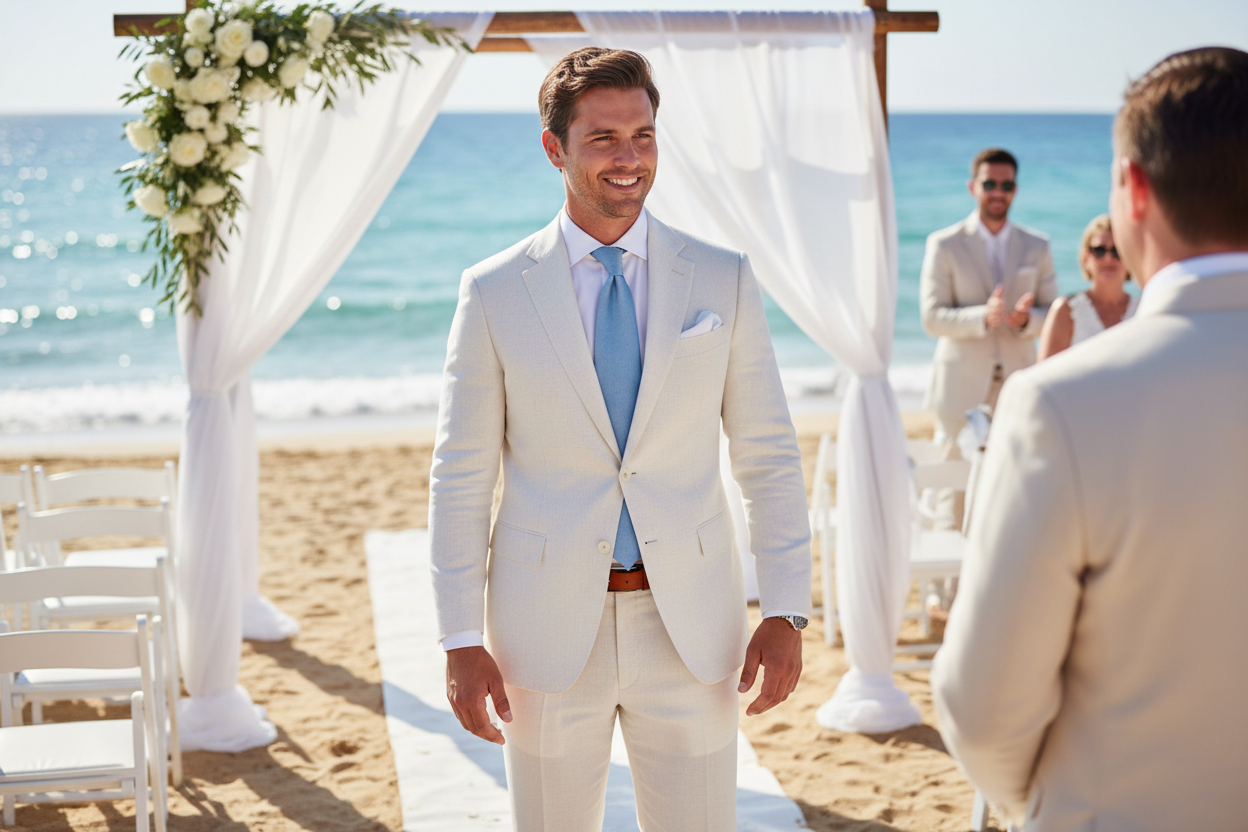
The white or ivory linen suit is the summer groom's most powerful statement. It is romantic, confident, and unmistakably intentional. Pair with a white linen shirt, no tie, and a single white gardenia boutonniere. For a beach ceremony, white leather loafers or even bare feet. For a rooftop or hotel venue, white leather Oxfords and a pale blue silk pocket square.
If white feels too bold, a pale grey or sky blue slim-fit suit in tropical wool is equally elegant — and more versatile across different venue types.
The Guest's Summer Look
Summer gives guests the most creative latitude. A linen blazer in tan or pale blue worn with tailored chinos and a white shirt is perfectly appropriate for a garden or beach wedding. For a more formal summer event, a two-piece suit in tropical wool — stone, pale grey, or light navy — with a white shirt and a silk tie in a bold summer colour (coral, cobalt, emerald) strikes the right balance.
IV. Autumn Weddings — The Season of Depth


When: September through November. Autumn is widely considered the most photogenic wedding season. The light is warm and golden, the foliage is spectacular, and the temperatures are forgiving — cool enough for a full suit, warm enough for outdoor ceremonies.
The Seasonal Imperative
Autumn rewards depth and richness. This is the season to move away from the pale, airy tones of spring and summer and embrace colours and textures that have weight and character. Charcoal, deep navy, forest green, burgundy, and rich brown are all at home in autumn's amber light. Fabrics can be heavier, and the three-piece suit — with its waistcoat — comes into its own.
- Fabrics: Mid-to-heavy wool (280–320 GSM), tweed, flannel, wool-cashmere blends
- Colours: Charcoal grey, deep navy, forest green, burgundy, camel, rich brown
- Silhouette: Slim or tailored fit; three-piece for maximum formality
- Lapel: Peak lapel for a bold, architectural look; notch for classic restraint
- Shirt: White or pale blue; consider a subtle texture like herringbone
- Tie: Silk in burgundy, forest green, deep gold, or rich navy
- Shoes: Dark brown or oxblood leather Oxfords or brogues
- Pocket square: Silk in a complementary jewel tone or a classic white linen
The Groom's Autumn Look
Autumn is the season for the groom to make a truly memorable statement. A charcoal grey three-piece suit with a peak lapel, a white spread-collar shirt, and a deep burgundy silk tie is a combination that photographs magnificently against autumn foliage. Add oxblood leather Oxfords, a matching pocket square, and a dark red rose boutonniere for a look of complete, considered elegance.
For a more contemporary approach, a deep navy double-breasted suit with gold buttons — worn with a white shirt and no tie — reads as modern and confident without sacrificing formality.
The Guest's Autumn Look
Autumn gives guests the richest palette to work with. A deep navy or charcoal two-piece suit with a white shirt and a silk tie in forest green or burgundy is impeccably appropriate. For a more relaxed autumn wedding, a tweed or flannel blazer in brown or grey worn with tailored dark trousers and a white shirt strikes a sophisticated, seasonal note.
V. Winter Weddings — The Pinnacle of Formality


When: December through February. Winter weddings are almost always held indoors — in grand ballrooms, historic churches, luxury hotels, and candlelit manor houses. The setting is inherently theatrical, and the dress code reflects it: this is the season for the most formal, most considered, most luxurious suiting of the year.
The Seasonal Imperative
Winter demands weight, richness, and drama. This is the season where velvet, heavy wool, and cashmere blends come into their own. Colours should be deep and saturated — midnight navy, jet black, forest green, deep burgundy, or even a daring dark plum. The three-piece suit is not merely appropriate in winter; it is expected at formal events. And if the invitation reads "black tie," a velvet dinner jacket or a classic tuxedo is the only correct response.
- Fabrics: Heavy wool (320+ GSM), velvet, cashmere blends, flannel
- Colours: Midnight navy, jet black, deep burgundy, forest green, dark plum, charcoal
- Silhouette: Slim or tailored fit; three-piece or tuxedo for black tie
- Lapel: Shawl lapel for tuxedos; peak lapel for formal suits
- Shirt: White poplin or white dress shirt; wing collar for black tie
- Tie: Silk bow tie for black tie; silk tie in deep jewel tones for formal suits
- Shoes: Black patent leather Oxfords for black tie; dark brown or black leather for formal suits
- Pocket square: White silk for black tie; silk in a complementary jewel tone for formal suits
The Groom's Winter Look
Winter is the season where the groom can be most dramatic. A midnight navy velvet suit with a shawl lapel, a white dress shirt, a black silk bow tie, and black patent leather Oxfords is a look of absolute, uncompromising elegance. The velvet catches the candlelight in a way that no other fabric can, and the shawl lapel gives the silhouette a romantic, cinematic quality.
For a more traditional approach, a jet black three-piece suit with a peak lapel, a white shirt, and a deep burgundy silk tie is a timeless combination that will look as distinguished in photographs decades from now as it does on the day.
The Guest's Winter Look
Winter guests should err on the side of formality. A charcoal or midnight navy three-piece suit with a white shirt and a silk tie in deep burgundy or forest green is impeccably appropriate for any winter wedding. If the event is black tie, a classic tuxedo — black or midnight navy — with a white dress shirt and a black silk bow tie is the only correct choice. Never wear a regular suit to a black tie wedding.
VI. The Details That Define the Look
Across every season, it is the details that separate a man who is merely wearing a suit from a man who is truly dressed. These are the elements that require the most attention — and reward it most generously.
The Pocket Square
The pocket square is the single most impactful detail in men's formalwear. A white linen square in a flat presidential fold is appropriate for every season and every occasion. For spring and summer, a soft floral or geometric print adds personality. For autumn and winter, a silk square in a jewel tone adds depth. The rule: it should complement the tie, not match it exactly.
The Boutonniere
For the groom and groomsmen, the boutonniere is the floral punctuation mark of the look. In spring, white ranunculus or garden roses. In summer, a single white gardenia or tropical bloom. In autumn, a dark red rose or a sprig of eucalyptus. In winter, a white amaryllis or a simple white camellia. Keep it small, keep it elegant, and pin it to the left lapel buttonhole.
The Shoe
The shoe is where many men make their most costly mistake. A beautiful suit worn with the wrong shoe undermines the entire look. The rule is simple: the shoe should be as well-made and as carefully chosen as the suit itself. For formal weddings, a Goodyear-welted Oxford in black or dark brown is the gold standard. For summer and garden weddings, a tan or cognac Derby or loafer is equally appropriate.
The Watch
A dress watch — slim, leather-strapped, with a clean dial — is the only appropriate timepiece for a wedding. Leave the sports watch and the smartwatch at home. The watch should be understated; it is a detail, not a statement.
Fit Above All
No detail matters more than fit. A moderately priced suit that fits perfectly will always look better than an expensive suit that does not. The jacket shoulder should sit precisely at the edge of your shoulder. The sleeve should show approximately 1.5 cm of shirt cuff. The trouser break should be minimal — a slight touch at the top of the shoe. If your suit does not fit perfectly off the rack, invest in a tailor.
VII. Groomsmen — Coordinating Without Uniformity
The question of how to dress groomsmen is one that every groom must navigate. The traditional approach — identical suits in the same colour and cut — remains the most cohesive and photographically satisfying solution. But there is a more contemporary approach that is gaining ground: the coordinated-but-not-identical look.
The Matching Approach
Choose a single suit in a colour and cut that flatters the broadest range of body types. Light grey and navy are the most universally flattering choices. Ensure every groomsman is properly fitted — alterations are not optional. Coordinate ties, pocket squares, and boutonnieres for a unified look.
The Coordinated Approach
Allow each groomsman to wear a suit in a similar colour family — all grey, or all navy — but in their own preferred shade and cut. Unify the look through a shared tie colour or pocket square. This approach is more relaxed and allows each man to wear a suit he already owns or will wear again.
The Groom's Distinction
Regardless of which approach you choose, the groom must be visually distinct from his groomsmen. This can be achieved through colour (the groom in ivory, groomsmen in grey), through the addition of a waistcoat, or through a different tie or boutonniere. The groom should be immediately identifiable in every photograph.
Shop the Wedding Collection
From light grey spring suits to midnight navy velvet for winter — every look in this guide is available at Aesido. Crafted for the man who understands that a wedding is not just an occasion. It is a statement.
Explore Wedding SuitsVIII. A Final Word on Dressing with Intention
The man who dresses well for a wedding does not do so by accident. He thinks about the season, the venue, the dress code, and the occasion. He chooses his fabric with care, his colour with intention, and his details with precision. He understands that a suit is not merely clothing — it is a form of communication.
At Aesido, every suit we make is designed for exactly this kind of man. Not the man who wants to be noticed, but the man who wants to be remembered — for the right reasons, in the right way, at the right moment.
Whatever the season, whatever the occasion, dress with the conviction that you belong there. Because you do.
Aesido — Precision Tailoring for the Modern Gentleman