
The Aesido Fit Guide
The Complete Men's Suit Fit Guide
Slim Fit · Regular Fit · Modern Fit · How a Suit Should Fit
The difference between a suit that looks expensive and one that looks ordinary is rarely the fabric or the price tag — it’s the fit. A perfectly fitted suit commands a room. A poorly fitted one, regardless of its quality, undermines everything.
This guide is designed to help you understand the three primary suit silhouettes available today, identify which works best for your body type, and know exactly what to look for when assessing fit — from the shoulder seam to the trouser break. Whether you’re buying your first suit or refining a wardrobe, this is the reference you’ll return to.

A well-fitted suit is the foundation of every man’s wardrobe.
“Fit is the single most important element of a well-dressed man. Before fabric, before colour, before price — fit defines everything.”
01 — Slim Fit vs Regular Fit
The most fundamental choice in suit shopping is between a Slim Fit and a Regular Fit. These two silhouettes represent opposite ends of the tailoring spectrum, and understanding the difference will immediately narrow down your options.

Left: Slim Fit — clean, tapered silhouette. Right: Regular Fit — relaxed, classic proportions.
Body Type: Who Should Wear Each?
Slim Fit suits are engineered for men with a lean, athletic, or naturally narrow build. The jacket is cut close to the torso with a pronounced waist suppression, and the trousers taper from the thigh downward. This silhouette celebrates a defined physique — but it requires one. If you carry weight in the midsection or have broader hips, a Slim Fit will pull, bunch, and ultimately look worse than a Regular Fit on the same body.
Regular Fit suits offer a more generous cut through the chest, waist, and seat. They are designed for men with a broader, stockier, or more athletic build — particularly those with developed shoulders or a fuller midsection. The silhouette is classic and timeless, with a straight line from shoulder to hem rather than a tapered waist.
Slim Fit
- Close-cut through chest and waist
- Pronounced waist suppression
- Tapered trouser leg
- Best for: lean, athletic, or slim builds
- Ideal chest-to-waist drop: 6–7 inches
Regular Fit
- Generous cut through chest and waist
- Minimal waist suppression
- Straight or slightly tapered trouser
- Best for: broader, stockier, or fuller builds
- Ideal chest-to-waist drop: 4–5 inches

Slim Fit: clean waist suppression and tapered silhouette.

Regular Fit: relaxed, classic proportions with room to move.
Comfort
Comfort is where Regular Fit has a clear advantage. The additional room through the chest, shoulders, and seat means you can move freely — raise your arms, sit for extended periods, or reach across a table without feeling restricted. For men who wear suits all day in professional environments, this matters enormously.
Slim Fit suits, by contrast, prioritise silhouette over ease of movement. They are best suited to occasions where you’ll be standing, presenting, or socialising — rather than sitting at a desk for eight hours.
Formality
Both fits are appropriate for formal occasions, but they carry different connotations. Regular Fit reads as more traditional and authoritative — it’s the silhouette of boardrooms, courtrooms, and black-tie events. Slim Fit reads as more contemporary and fashion-forward — it’s the silhouette of creative industries, modern weddings, and international business culture.
| Occasion | Slim Fit | Regular Fit |
|---|---|---|
| Business meetings | ✓ Modern, sharp | ✓ Classic, authoritative |
| Weddings | ✓ Contemporary | ✓ Traditional |
| Black tie / formal | ✓ Fashion-forward | ✓ Conventional choice |
| All-day office wear | △ Less comfortable | ✓ More comfortable |
| Travel | △ Restrictive | ✓ Easier movement |
Aesido Recommendation: If you’re between sizes or unsure, always size up and have the suit tailored in. It’s far easier — and less expensive — to take a suit in than to let one out.
02 — The Modern Fit Suit
If Slim Fit and Regular Fit represent two poles, Modern Fit is the intelligent middle ground — and for most men, it’s the most flattering and versatile option available.

The Modern Fit: the dominant silhouette in contemporary European and American tailoring.
The Dominant Silhouette in Western Tailoring
Walk into any premium menswear retailer in London, Milan, New York, or Paris, and the majority of suits on the floor will be Modern Fit. It has become the default silhouette of contemporary tailoring because it solves the central problem of menswear: how to look sharp without sacrificing comfort.
Modern Fit sits between Slim and Regular — it has more structure and waist definition than a Regular Fit, but more room through the chest and seat than a Slim Fit. The trouser is cut with a clean, straight leg that tapers slightly at the ankle without being tight. The result is a suit that photographs beautifully, moves comfortably, and works across a wide range of body types.

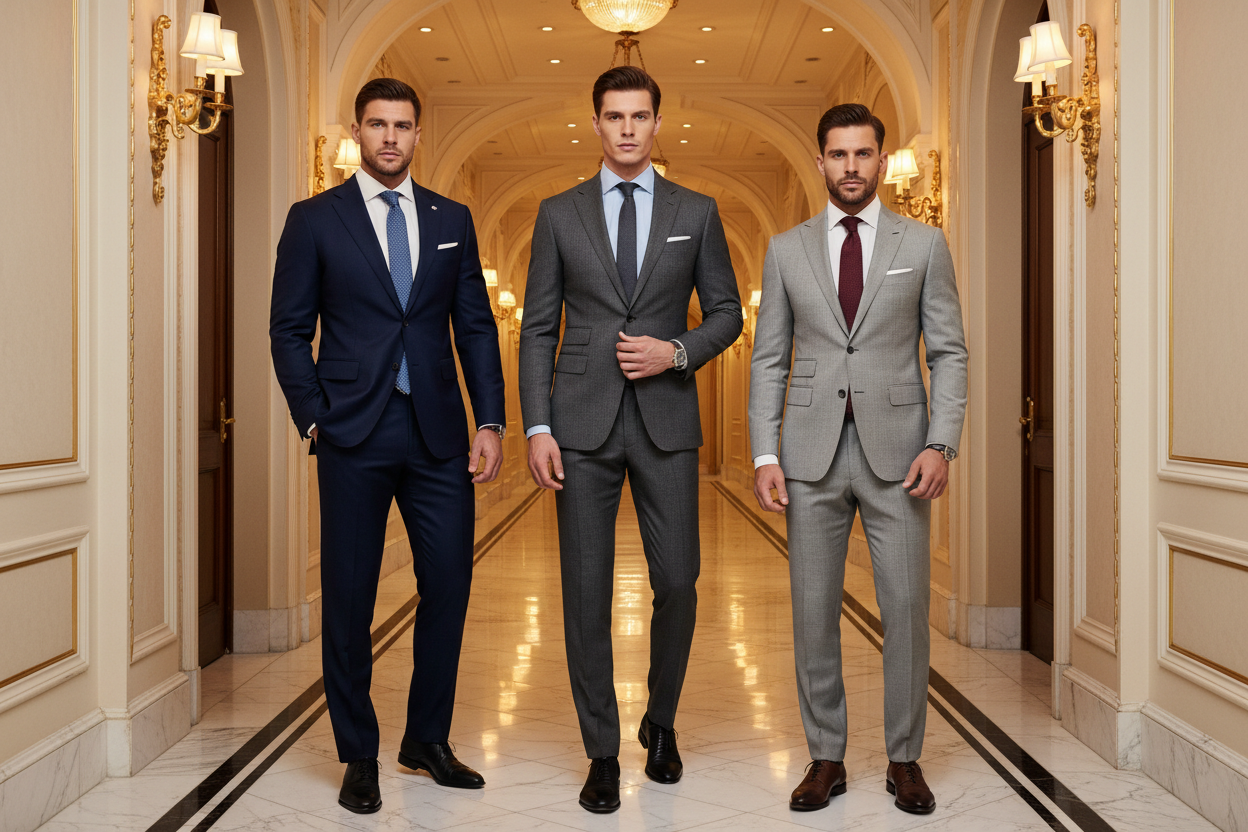
Modern Fit works across a broad range of body types — the most versatile silhouette in contemporary tailoring.
More Comfortable Than Slim — Without Sacrificing Shape
The key advantage of Modern Fit is that it retains the visual elegance of a tailored silhouette while adding meaningful comfort. The chest has enough room to breathe. The seat isn’t pulling. You can sit through a dinner without feeling like the jacket is fighting you. Yet when you stand, the suit still has a clean, defined line that reads as intentional and polished.
Who It’s For
- Men who want a sharp look without restriction
- Average to athletic builds
- Men who wear suits regularly
- Those buying a first or versatile suit
- Men between Slim and Regular sizing
Key Characteristics
- Moderate waist suppression
- Clean chest with room to move
- Straight-tapered trouser leg
- Structured but not padded shoulder
- Works for business and formal occasions
Modern Fit is the suit equivalent of a well-engineered sports car: it performs beautifully under pressure, looks exceptional at rest, and doesn’t ask you to compromise.
Aesido Note: All of our core suit styles are cut in a Modern Fit silhouette, informed by European tailoring traditions. We’ve engineered the waist suppression and chest room to work across a broad range of body types without requiring alterations in most cases.
03 — How Should a Suit Fit?
Knowing the difference between fit styles is only half the equation. The other half is understanding the specific checkpoints that determine whether a suit actually fits your body — regardless of what the label says. Here are the four critical fit checkpoints, in order of importance.
1. The Shoulder — The Most Important Checkpoint
The shoulder seam is the single most important fit point on a suit jacket, and it’s also the most expensive to alter. The shoulder seam should sit exactly at the edge of your shoulder — not hanging over onto your arm, and not pulling inward toward your neck. There should be no divots, no bunching, and no fabric pulling away from your body.

The shoulder seam sits precisely at the shoulder’s edge — the hallmark of a well-fitted jacket.
Rule: Always fit the suit to your shoulders first. Everything else can be altered. The shoulder cannot.
2. Sleeve Length — The Shirt Cuff Rule
The jacket sleeve should end approximately 1–2 cm above the shirt cuff, allowing the shirt to show at the wrist. If the jacket sleeve covers the shirt entirely, the suit looks too long in the arm. If the shirt shows more than 2 cm, the jacket looks too short. The 1–2 cm exposure is the precise window that signals intentionality and attention to detail.

1–2 cm of shirt cuff visible at the wrist — the correct sleeve length in tailored dressing.
Practical note: Sleeve length is one of the easiest and least expensive alterations a tailor can make. If everything else fits, don’t let sleeve length stop you from buying a suit.
3. Trouser Break — A Matter of Preference and Proportion
The “break” refers to the fold or crease that forms where the trouser leg meets the top of the shoe. The right choice depends on your proportions, the occasion, and your personal aesthetic.

The trouser break: a small detail with a significant impact on the overall silhouette.
| Break Type | Description | Best For |
|---|---|---|
| No Break | Trouser ends just above the shoe, no fold | Slim builds, contemporary look |
| Slight Break | A small, clean fold at the front of the shoe | Most men — universally flattering |
| Half Break | A moderate fold, fabric rests on the shoe | Classic business dress |
| Full Break | Significant fold, fabric pools at the shoe | Traditional formal wear |
4. Chest Fit — The Button Test
When you button the jacket, the fabric across the chest should lie flat. There should be no pulling, no X-shaped creases radiating from the button, and no visible strain at the lapels. A simple test: button the jacket and try to slip your hand flat inside the lapel. You should be able to do so with moderate ease — not so easily that the jacket is loose, and not so tightly that you have to force it.

Correct chest fit: fabric lies flat, lapels clean, no strain.
Correct proportions across different body types — Modern Fit at its best.
Signs It’s Too Tight
- X-shaped creases from the button
- Lapels pulling away from the chest
- Difficulty breathing deeply
- Jacket rides up when you move
- Buttons straining at the holes
Signs It’s Too Loose
- Fabric hangs away from the torso
- Shoulder seams drooping
- Excess fabric at the back
- Jacket looks shapeless when buttoned
- Lapels don’t lie flat
A suit that fits correctly should feel like a second skin — present but not restrictive. You should be aware of it without being constrained by it.
Final Thought: The best suit you’ll ever own is the one that fits your body, suits your lifestyle, and makes you feel confident the moment you put it on. Use this guide as your reference — and when in doubt, reach out to our team. We’re here to help you find the right fit, the first time.