
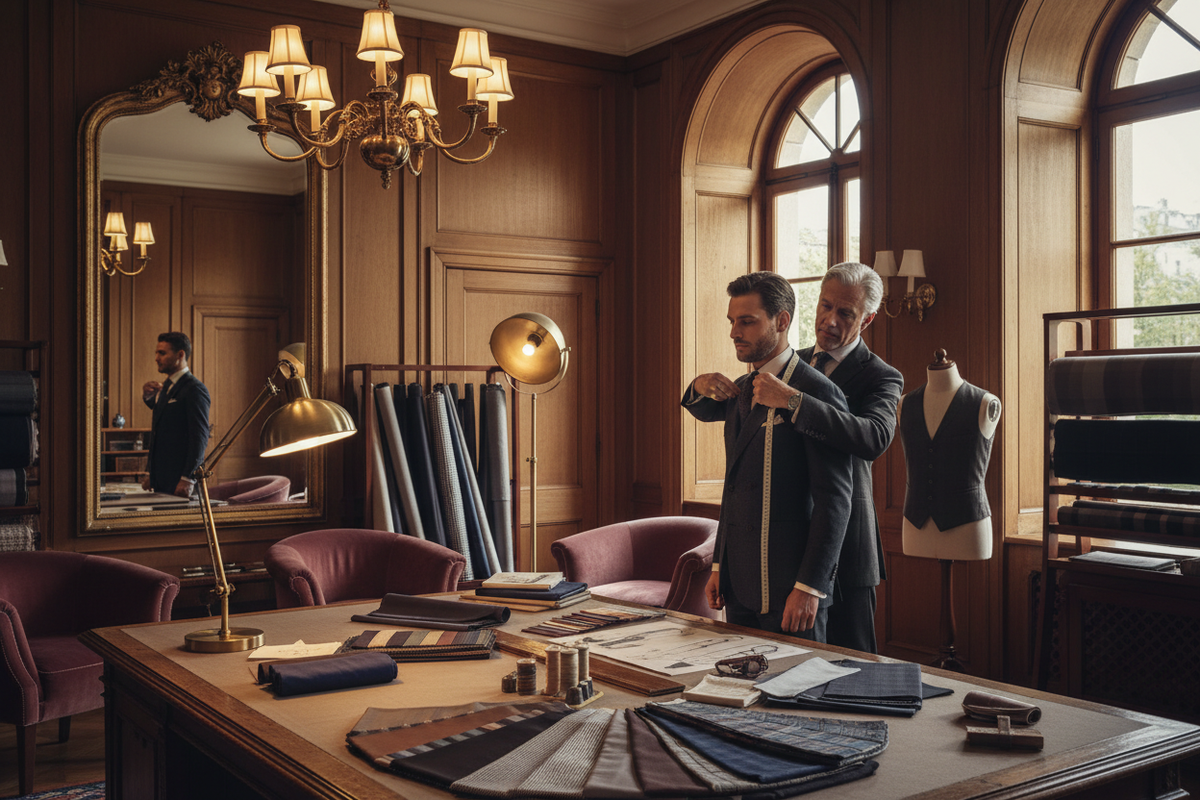
A suit off the rack is made for no one in particular. A custom suit is made for one person only: you.

Whether you're preparing for a wedding, a pivotal business moment, or simply investing in a wardrobe that reflects who you are — a bespoke suit is one of the most considered, lasting decisions a man can make. This guide will walk you through everything: why custom tailoring matters, how the process works, and exactly what information you need to provide to ensure a result that is nothing short of perfect.
I. Why Choose a Custom Suit?
1. Fit That Cannot Be Replicated Off the Rack

The human body does not conform to standard sizing. Shoulders vary in slope and width. Torsos differ in length. Arms are rarely symmetrical. A ready-to-wear suit is engineered around an average — and most men are not average.
A custom suit is built around your body. Every seam, every dart, every panel is positioned to follow your specific proportions. The result is a silhouette that looks effortless because it was designed to be effortless — on you, specifically.
2. Complete Creative Control

When you commission a custom suit, you make every decision:
- Fabric: From fine Italian wool to breathable linen, from classic navy to bespoke patterns
- Lapel style: Notch, peak, or shawl — each communicates something different
- Button stance: Single or double-breasted, one to four buttons
- Lining: Full, half, or unlined — functional and expressive
- Details: Working buttonholes, ticket pockets, surgeon's cuffs, monogramming
No two custom suits are alike. Yours will be singular.
3. Superior Craftsmanship and Longevity
A well-made custom suit, properly cared for, will outlast a dozen off-the-rack alternatives. The construction methods used in bespoke tailoring — hand-stitched canvassing, precise seam allowances, reinforced stress points — are designed for decades of wear, not seasons.
4. An Investment, Not an Expense
The cost-per-wear of a custom suit, calculated over its lifespan, is often lower than that of a cheaper ready-to-wear alternative replaced every few years. More importantly, the confidence it provides — in every meeting, every occasion, every photograph — is incalculable.
II. The Bespoke Process: Step by Step
Step 1 — Consultation
The process begins with a conversation. Your tailor will discuss your lifestyle, the occasions you dress for, your aesthetic preferences, and your budget. This is the foundation of everything that follows. Come prepared with references — photographs of suits you admire, details you want to incorporate, and a clear sense of how you want to feel when you wear it.
Step 2 — Fabric Selection
You will be presented with a curated selection of fabrics appropriate to your needs. Your tailor will guide you through weight, weave, and composition — helping you understand how each fabric will perform in different seasons and settings. Take your time here. The fabric is the soul of the suit.
Step 3 — Measurement

This is the most critical stage of the process. A comprehensive set of measurements will be taken — typically 20 to 30 individual measurements — to map your body with precision. (See Section III for the complete measurement guide.)
Step 4 — Pattern Creation
Using your measurements, your tailor creates a unique paper pattern — the blueprint of your suit. Unlike made-to-measure services that modify an existing block, true bespoke patterns are drafted from scratch for your body alone.
Step 5 — Basting Fitting
A rough version of the suit — called a baste — is assembled in the actual fabric and fitted on your body. This is where adjustments are made before any final stitching. Expect to try the suit on two to three times before it is complete.
Step 6 — Final Fitting & Delivery

The finished suit is presented for a final fitting. Minor adjustments may be made. Once approved, the suit is yours — along with your pattern, which is retained for future commissions.
III. The Essential Measurements: What Your Tailor Needs
Accurate measurements are the difference between a suit that fits and a suit that transforms. Below is a complete guide to every measurement required — and why each one matters.

🔹 Upper Body
| Measurement | How to Take It | Why It Matters |
|---|---|---|
| Chest | Around the fullest part of the chest, tape parallel to the floor | Determines the primary size of the jacket body |
| Waist | Around the natural waist, approximately 2.5cm above the navel | Controls the suppression and shape of the jacket |
| Seat / Hips | Around the fullest part of the seat | Critical for trouser fit and jacket length |
| Shoulder Width | Across the back, from shoulder point to shoulder point | The single most important measurement — cannot be altered after construction |
| Back Length | From the base of the neck (7th cervical vertebra) to the natural waist | Determines jacket length and proportion |
| Chest to Waist Drop | Difference between chest and waist measurements | Defines how much the jacket is shaped |
🔹 Arms
| Measurement | How to Take It | Why It Matters |
|---|---|---|
| Sleeve Length | From shoulder point to wrist bone, arm slightly bent | Ensures correct shirt cuff exposure (1.5–2cm) |
| Bicep | Around the fullest part of the upper arm, relaxed | Prevents restriction of movement |
| Wrist | Around the wrist bone | Determines sleeve opening width |
🔹 Trousers
| Measurement | How to Take It | Why It Matters |
|---|---|---|
| Trouser Waist | Where you prefer to wear your trousers (natural waist or hip) | Establishes the trouser rise and waistband position |
| Inseam | From the crotch to the desired hem length | Determines trouser break over the shoe |
| Outseam | From the waistband to the hem along the outside of the leg | Confirms overall trouser length |
| Thigh | Around the fullest part of the upper thigh | Ensures comfort when seated and walking |
| Knee | Around the knee, standing straight | Controls the taper of the trouser leg |
| Hem / Ankle | Around the ankle at the desired hem opening | Defines the trouser silhouette — slim, straight, or wide |
| Rise | From the waistband to the crotch seam, front and back | Critical for seated comfort and overall proportion |
🔹 Posture & Body Notes
Beyond measurements, your tailor will observe and note:
- Shoulder slope: Whether one shoulder sits higher than the other (extremely common)
- Posture: Forward lean, upright, or swayback — affects jacket balance
- Chest shape: Flat, full, or asymmetrical
- Stomach prominence: Affects front button stance and jacket drape
- Arm position: How the arms hang naturally at rest
These observations cannot be captured by a tape measure alone — they are why an in-person fitting is irreplaceable.
IV. What to Bring to Your First Appointment
To make the most of your consultation, come prepared with the following:
- A well-fitting reference garment: A shirt or jacket that fits you well gives your tailor an immediate reference point
- Your intended footwear: Trouser length is calibrated to the heel height of the shoes you'll wear with the suit
- Visual references: Screenshots or photographs of suits, details, or silhouettes you admire
- Your schedule: Custom suits typically require 5–7 days from first fitting to delivery — plan accordingly
- Clarity on occasion: A wedding suit, a boardroom suit, and a summer travel suit are three very different briefs
V. Frequently Asked Questions
How long does a custom suit take?
Aesido fully bespoke suits typically require 5–7 days, while expedited service can be completed within 3 to 5 days.
Can I order remotely without an in-person fitting?
Yes — with a comprehensive self-measurement guide and detailed photographs, remote commissions are possible. However, we strongly recommend an in-person fitting for first-time clients to ensure the pattern is established correctly.
What if the suit doesn't fit perfectly on delivery?
Minor adjustments are a normal part of the process and are included as standard. Your pattern is retained and refined with each commission.
How should I care for my custom suit?
Hang on a wide wooden hanger after each wear. Allow 24 hours between wearings. Steam rather than iron where possible. Dry clean sparingly — no more than once or twice per season.
Closing
A custom suit is not a luxury reserved for a select few. It is a decision available to any man who values how he presents himself to the world — and who understands that the way you dress shapes the way you are perceived, and the way you feel.
When you invest in a suit made specifically for your body, your lifestyle, and your vision, you are not simply buying clothing. You are commissioning something that will represent you — precisely, permanently, and without compromise.
We are here to guide you through every step of that process.
Ready to begin? Contact us to schedule your first consultation and take the first step toward a suit that is entirely your own.